
Dashboard / Lake / Walchensee, Urfeld shore
Walchensee, Urfeld shore
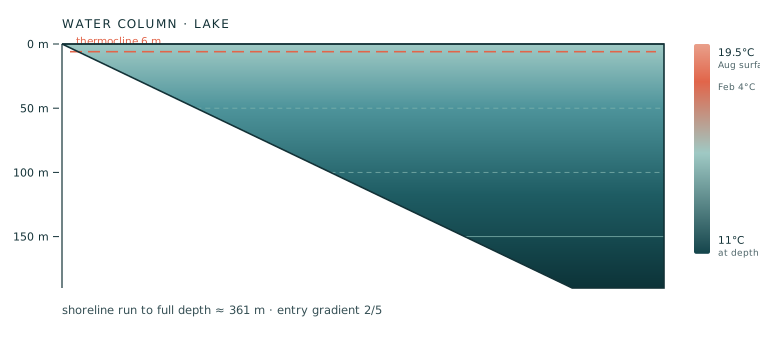
The deepest large lake in the German Alps — 190 m — and the reason it stays turquoise: a huge depth of water absorbs red light and reflects blue back.
Monthly water temperature temperature
The surface runs about 19.5 °C in August. The annual low is 4 °C in January and the high is 19.5 °C in July. The summer thermocline sits at about 6 m, where the temperature drops sharply. For October, the mean surface figure is 13 °C.
| Jan | Feb | Mar | Apr | May | Jun | Jul | Aug | Sep | Oct | Nov | Dec |
|---|---|---|---|---|---|---|---|---|---|---|---|
| 4 | 4 | 5.5 | 9 | 13.5 | 17.5 | 19.5 | 19.5 | 17 | 13 | 8.5 | 5.5 |
Safety safety
Drinking-water quality. Walchensee is oligotrophic with visibility routinely over 8 m, and the Bavarian environment agency classifies the whole lake as suitable for bathing with no advisory notices in the last five seasons.
Safety notes (3)
- The thermocline is the hazard, not the distance. Crossing it suddenly can trigger cold shock 200 m from shore with no warning at the surface.
- Afternoon wind builds a genuine chop from 14:00. The lake funnels wind between the Herzogstand and Jochberg ridges; the return leg into a headwind is twice the effort of the outward leg.
- Motorboats and sailing dinghies launch from the jetty. Keep 50 m clear of the harbour mouth.
Where to get in
- Gravel shelf — North of the Urfeld jetty; firm gravel, 1.5 m at 8 m out, no weed.
- Jetty ladder — Aluminium ladder off the jetty end into 3 m of water. Convenient for a straight swim, but the jetty is a boat berth in the mornings.
On site
- Boat hire, two lakeside restaurants, campsite 600 m south
- Changing huts (three, unisex) at the north end
- No lifeguard; the DLRG operates a weekend watch station in July and August
Getting there arrival · entry · exit
Getting there
Urfeld is 20 minutes from Kochel on the B11. Park at the lakeside lot and walk north along the shore path for four minutes to the gravel shelf — the shelf is obvious because it is the only place where the shore is not walled.
Arrive before 09:00 in August. The car park is the only public one on the north shore and it fills completely on hot weekends by mid-morning.
Getting in
Walk in over the gravel and stay in the top two metres for the first five minutes. The surface layer is genuinely warm — 19–20 °C in August — and it is easy to believe the whole lake is like this.
Swim parallel to the shore, not out. A 400 m out-and-back along the shelf keeps you over 2–4 m of water where any problem is solvable; heading straight out puts you over 40 m within three minutes.
Getting out
Use the same gravel shelf. If the afternoon chop has built, approach at 45 degrees to the waves rather than straight into them — you will make the shore faster and take on less water.
Change in the huts at the north end rather than on the shelf. The gravel is coarse and uncomfortable underfoot once your feet are numb.
Depth profile
A textbook Alpine profile: gravel shelf to 1.5 m within 8 m of the shore, then a steep 30-degree drop into open water. Within 40 m of the bank you are already over 20 m of water. The thermocline sits at about 6 m in July and August — cross it and the temperature falls from 19 °C to 11 °C in under two metres.
Season window
June to September; the lake reaches 20 °C only in the top two metres
Cold-water questions
- Why is Walchensee so blue?
- Two things: extreme depth (190 m) means light travels far through the water before returning, and the lake is oligotrophic, so there are almost no algae or suspended particles to scatter other wavelengths.
- How deep is the thermocline in summer?
- Around 6 m in July and August. Below it the water drops to 8–11 °C and stays there all summer.
Before you get in
Cold water is the one hazard that applies everywhere in this library. Below 15 °C the gasp reflex can make you inhale water involuntarily within seconds of immersion; below 10 °C, unacclimatised swimmers lose the ability to swim effectively within minutes. Enter gradually, keep your first session under five minutes, never swim alone, and get out while you still feel fine — the afterdrop continues after you leave the water.
Informational only. Stillwater is not a safety authority, a lifeguard service or a medical source, and nothing here is professional advice. Water conditions change within hours: temperatures are monthly means, not today's reading, and depth profiles are typical rather than surveyed. Before you enter any water, check the current conditions, read the on-site signage, follow the advice of local lifeguards above anything on this page, and if you are unsure of your ability in cold water, do not go in.
Other spots of the same water type
| Lac d'Annecy, Plage de la Brune | Haute-Savoie, France | 65 m | 14.5° October |
| Buttermere | Lake District, England | 23 m | 11° October |
| Lake Bled, Velika Zaka | Gorenjska, Slovenia | 29.5 m | 15.5° October |
| Loch Morlich | Cairngorms, Scotland | 12 m | 10° October |