
Buttermere
The Lake District's most swimmable lake: no motorboats, no development, a 7 km shoreline path, and a shingle spit that gives deep water ten metres from the bank.
Monthly water temperature temperature
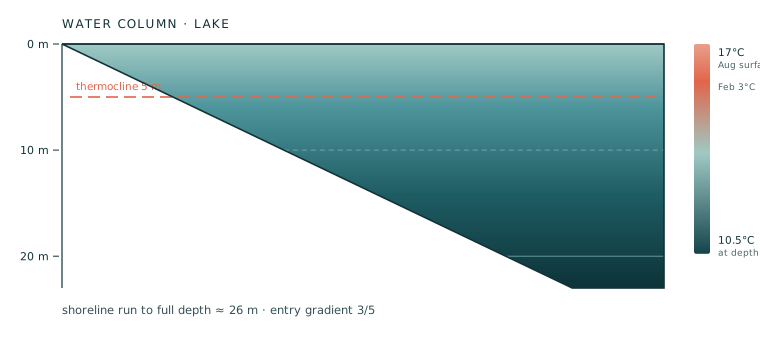
The surface runs about 17 °C in August. The annual low is 3 °C in January and the high is 17 °C in July. The summer thermocline sits at about 5 m, where the temperature drops sharply. For October, the mean surface figure is 11 °C.
| Jan | Feb | Mar | Apr | May | Jun | Jul | Aug | Sep | Oct | Nov | Dec |
|---|---|---|---|---|---|---|---|---|---|---|---|
| 3 | 3 | 4.5 | 7.5 | 11.5 | 15 | 17 | 17 | 15 | 11 | 7 | 4.5 |
Safety safety
Buttermere has no sewage discharge and no agricultural intensification in its catchment. Environment Agency sampling has returned Excellent every year since 2015, and the water is clear enough to see the lake bed at 4 m in calm conditions.
Safety notes (3)
- The drop from the shingle spit is immediate: 10 m of shallow then 3 m, then 8 m at 30 m. Weak swimmers should use the north silt shelf instead.
- Cold water at 17 °C surface becomes 9 °C below the 5 m thermocline. Do not duck-dive the deep water without a wetsuit.
- There are no motorboats, but the Buttermere swim run and triathlon events use the lake on set weekends. Check the National Trust noticeboard at the car park.
Where to get in
- Shingle spit — South-east shore below Crag Hill; 10 m of shingle then 3 m depth. Not a beach for children.
- Silt shelf wade — North end near the car park; 100 m of shallow water, soft underfoot, better for a gentle dip.
On site
- Two cafés in Buttermere village (the village is 800 m from the north shore)
- Public toilets at the car park, 50p
- No lifeguard; the nearest mountain rescue base is Cockermouth, 20 minutes
Getting there arrival · entry · exit
Getting there
From the National Trust car park, take the lakeshore path south. The shingle spit is 1.2 km along, on the eastern side, marked by a stand of birch that comes right down to the water.
If you only have an hour, use the north silt shelf directly in front of the car park — it is 100 m of waist-deep water and gives you a swim without any walk at all.
Getting in
From the spit, step in and start swimming immediately. There is no wading phase here; the shingle falls away at about 1:3.
Swim a 300 m line parallel to the shore, keeping the spit visible on your left. At 3–6 m depth you have clean water, no weed, and a shoreline that is never more than a minute away.
Getting out
Return to the spit. Its shingle is coarse but stable, and there is a flat grass ledge above the waterline for changing.
Walk back to the car park in dry clothes. The 1.2 km return is flat but fully exposed, and Buttermere's valley wind is strong even when the lake looks calm.
Depth profile
A distinctive profile: the northern end is shallow (1–2 m) over a wide silt shelf, but the centre of the lake reaches 23 m just 120 m from the eastern shore, because the valley walls drop straight into the water. The shingle spit below Crag Hill gives you 3 m within 10 m of land — the deepest quick entry in the Lake District.
Season window
June to September; the lake is 200 m above sea level and cools quickly in September
Cold-water questions
- Why is Buttermere considered the best swim lake in the Lake District?
- No motorboats, no sewage input, a 7 km shoreline path, and a shingle spit that gives 3 m of depth within 10 m of the bank — a combination no other Lake District lake has.
- How deep is Buttermere?
- 23 m at the deepest point, which lies only about 120 m off the eastern shore because the valley wall drops straight into the water.
Before you get in
Cold water is the one hazard that applies everywhere in this library. Below 15 °C the gasp reflex can make you inhale water involuntarily within seconds of immersion; below 10 °C, unacclimatised swimmers lose the ability to swim effectively within minutes. Enter gradually, keep your first session under five minutes, never swim alone, and get out while you still feel fine — the afterdrop continues after you leave the water.
Informational only. Stillwater is not a safety authority, a lifeguard service or a medical source, and nothing here is professional advice. Water conditions change within hours: temperatures are monthly means, not today's reading, and depth profiles are typical rather than surveyed. Before you enter any water, check the current conditions, read the on-site signage, follow the advice of local lifeguards above anything on this page, and if you are unsure of your ability in cold water, do not go in.
Other spots of the same water type
| Loch Morlich | Cairngorms, Scotland | 12 m | 10° October |
| Llyn Idwal | Snowdonia (Eryri), Wales | 12 m | 9° October |
| Walchensee, Urfeld shore | Bavaria, Germany | 190 m | 13° October |
| Lac d'Annecy, Plage de la Brune | Haute-Savoie, France | 65 m | 14.5° October |