
Llyn Idwal
A glacial cwm lake at 380 m in a rock bowl under Y Garn — a 25-minute walk in, no roads, no boats, and water so clear you can see the boulders at 6 m.
Monthly water temperature temperature
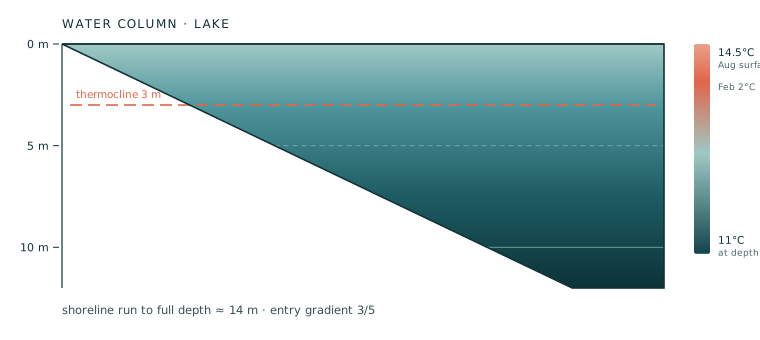
The surface runs about 14.5 °C in August. The annual low is 2 °C in January and the high is 14.5 °C in July. The summer thermocline sits at about 3 m, where the temperature drops sharply. For October, the mean surface figure is 9 °C.
| Jan | Feb | Mar | Apr | May | Jun | Jul | Aug | Sep | Oct | Nov | Dec |
|---|---|---|---|---|---|---|---|---|---|---|---|
| 2 | 2 | 3 | 5.5 | 9 | 12.5 | 14.5 | 14.5 | 12 | 9 | 5.5 | 3 |
Safety safety
No discharge, no livestock in the cwm, no road run-off. The water is acidic and extremely low in nutrients, which is why it is so clear and also why it holds almost no algae. Natural Resources Wales lists it as good for bathing.
Safety notes (3)
- There is no easy exit on the west shore. The cliff face comes straight down into deep water — commit to entering on the east or north side.
- At 380 m altitude, air temperature in the cwm is typically 3 °C below the Ogwen valley and wind chill is severe. Take a full change of clothes and a windproof layer.
- This is mountain country: the path is rough, mobile signal is absent, and mountain rescue callouts here are frequent. Tell someone your plan before you set off.
Where to get in
- Boulder slope — East shore under the Slabs; big stable blocks, better with river shoes, 3 m depth within a few steps.
- Peaty shelf — North inflow end; shallow and soft, good for a quick dip but silty underfoot.
On site
- None at the lake — no toilets, no shelter, no bins
- Ogwen Cottage visitor centre (toilets, café) at the car park
- No mobile signal in the cwm; the nearest phone is at Ogwen Cottage
Getting there arrival · entry · exit
Getting there
Park at Ogwen Cottage on the A5, cross the footbridge, and follow the stone path up through the gate. It is a steady 1.6 km climb with 150 m of ascent — 25 minutes at a walking pace, and the lake appears suddenly as the path crests the moraine.
Do not attempt this in sandals. The upper section is loose scree and wet slate; a turned ankle an hour from the road is a genuine problem.
Getting in
Enter from the boulder slope on the east shore. The blocks are large and stable; step down two or three of them and you are already out of your depth.
The swim is short by design: 200 m across the bowl and back, about 8 minutes. At 14 °C in August it is a swim to experience rather than to train in, and most people are out within 10 minutes.
Getting out
Climb out on the same boulder slope, taking the grassy ramp 20 m south of it — it is significantly easier than the blocks when your hands are cold.
Dress immediately, before the wind gets to you. The cwm funnels a steady northerly, and the walk back down is downhill, which means you generate very little heat.
Depth profile
Small but deep for its size: 12 m in the middle of a rock bowl barely 400 m across. The eastern shore below the Idwal Slabs is a boulder slope that falls at 1:2 — a few steps and you are in 3 m of water. The northern end is a shallow peaty shelf of 40–80 cm, fed by the stream from Cwm Idwal.
Season window
July to early September; the cwm holds snow into May most years
Cold-water questions
- Can you swim in Llyn Idwal?
- Yes — it is listed as a good bathing water by Natural Resources Wales and swimming is not restricted. It is cold (14 °C in August) and there is no lifeguard, so it suits competent swimmers.
- How long is the walk to Llyn Idwal?
- 1.6 km with 150 m of ascent from the A5 — about 25 minutes at a steady walking pace, on a rough stone path.
Before you get in
Cold water is the one hazard that applies everywhere in this library. Below 15 °C the gasp reflex can make you inhale water involuntarily within seconds of immersion; below 10 °C, unacclimatised swimmers lose the ability to swim effectively within minutes. Enter gradually, keep your first session under five minutes, never swim alone, and get out while you still feel fine — the afterdrop continues after you leave the water.
Informational only. Stillwater is not a safety authority, a lifeguard service or a medical source, and nothing here is professional advice. Water conditions change within hours: temperatures are monthly means, not today's reading, and depth profiles are typical rather than surveyed. Before you enter any water, check the current conditions, read the on-site signage, follow the advice of local lifeguards above anything on this page, and if you are unsure of your ability in cold water, do not go in.
Other spots of the same water type
| Loch Morlich | Cairngorms, Scotland | 12 m | 10° October |
| Buttermere | Lake District, England | 23 m | 11° October |
| Walchensee, Urfeld shore | Bavaria, Germany | 190 m | 13° October |
| Lac d'Annecy, Plage de la Brune | Haute-Savoie, France | 65 m | 14.5° October |