
Dashboard / River / Soča at Bovec
Soča at Bovec
The most photographed river in the Alps: an unnervingly clear turquoise channel over white limestone, cold enough in August to make a wetsuit worth carrying.
Monthly water temperature temperature
The surface runs about 14.5 °C in August. The annual low is 3.5 °C in January and the high is 14.5 °C in July. No pronounced summer thermocline is recorded here. For October, the mean surface figure is 9.5 °C.
| Jan | Feb | Mar | Apr | May | Jun | Jul | Aug | Sep | Oct | Nov | Dec |
|---|---|---|---|---|---|---|---|---|---|---|---|
| 3.5 | 3.5 | 5.5 | 8.5 | 11.5 | 13.5 | 14.5 | 14.5 | 12.5 | 9.5 | 6.5 | 4.5 |
Safety safety
Exceptionally clear but not sterile: the transparency comes from limestone filtration, not from treatment. Slovenian monitoring lists the Bovec stretch as suitable for bathing; the real hazard is the temperature, not the microbiology.
Safety notes (3)
- Cold-shock is the real risk: 14 °C water triggers an involuntary gasp reflex within seconds. Enter by wading, breathe out hard through pursed lips, and stay in the shallows for two full minutes before swimming.
- Limestone is polished by centuries of water. River shoes with rubber on rock, not felt, are the correct choice here.
- Thunderstorms build over the Julian Alps most afternoons in July. A 20-minute storm 15 km upstream can triple the flow here with no local warning — if the water turns milky, get out immediately.
Where to get in
- Gravel riffle wade-in — Shallowest line between the two pools; knee depth for 20 m, so you acclimatise before the drop-off.
- Rock ledge (advanced) — Right-hand limestone shelf, dry in low water, 1.5 m above a 3 m pool. Wet rock is slippery — this is a controlled step-in, not a jump.
On site
- Seasonal kiosk (July–August) with coffee and potica
- Compost toilets at the car park gate
- No lifeguard, no mobile signal in the gorge
Getting there arrival · entry · exit
Getting there
From Bovec, take the road towards Vršič for 4 km and turn onto the signed Vodenca track. The gate opens at 07:00; arriving before 09:00 means you park at the front and walk the 12 minutes down the gorge in shade.
The path descends steeply on the left bank for the last 200 m — tree roots, no handrail. Carry your kit in a dry bag on your back rather than a shoulder bag; you will want both hands.
Getting in
Use the gravel riffle. It gives you 20 m of knee-deep water, which is exactly the acclimatisation protocol you want for a 14 °C river: the first thirty seconds are the worst, and after ninety seconds the gasp reflex fades.
Swim the lower pool as a circuit rather than a crossing. It is roughly 25 m long and 12 m wide, so four laps is a real session. Keep your face in the water only in bursts of five or six strokes at first — the cold makes facial immersion genuinely uncomfortable.
Getting out
Exit onto the gravel riffle, not the limestone. The ledge that was dry when you entered will have been splashed by swimmers and is now the slickest surface in the gorge.
Wrap up before you walk. The 12-minute climb back to the car park generates no heat while you are wet, and the gorge shade is 5 °C cooler than Bovec. A fleece and a hat in the bag are not overkill in August.
Depth profile
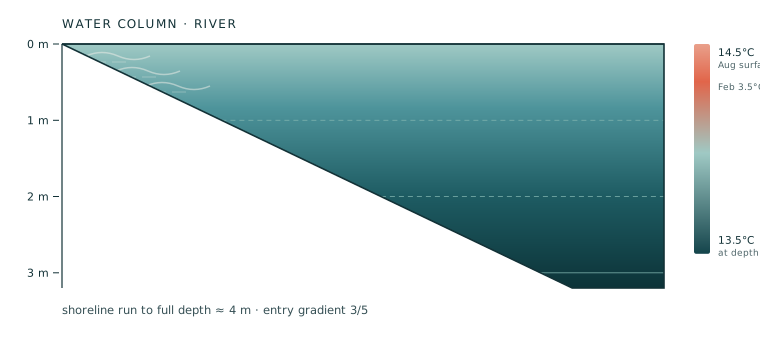
Two deep emerald pools in sequence, separated by a shallow 40 cm gravel riffle. The lower pool is the deeper of the two at 3.2 m and holds a distinct thermocline in July — 14 °C at the surface, 9 °C below two metres. You can feel it as a band across your shins when you tread water.
Season window
July to early September only; snowmelt keeps it under 15 °C even at the height of summer
Cold-water questions
- Why is the Soča so cold in August?
- Most of its summer flow is snowmelt released from the Triglav glacier and high karst springs, which emerge at 5–7 °C regardless of air temperature.
- Do I need a wetsuit?
- For a 10-minute dip, no. For anything over 20 minutes, a 3 mm shortie makes the difference between a good swim and a shivering retreat.
Before you get in
Cold water is the one hazard that applies everywhere in this library. Below 15 °C the gasp reflex can make you inhale water involuntarily within seconds of immersion; below 10 °C, unacclimatised swimmers lose the ability to swim effectively within minutes. Enter gradually, keep your first session under five minutes, never swim alone, and get out while you still feel fine — the afterdrop continues after you leave the water.
Informational only. Stillwater is not a safety authority, a lifeguard service or a medical source, and nothing here is professional advice. Water conditions change within hours: temperatures are monthly means, not today's reading, and depth profiles are typical rather than surveyed. Before you enter any water, check the current conditions, read the on-site signage, follow the advice of local lifeguards above anything on this page, and if you are unsure of your ability in cold water, do not go in.
Other spots of the same water type
| Verzasca at Lavertezzo | Ticino, Switzerland | 8 m | 11° October |
| River Wharfe at Grassington | Yorkshire Dales, England | 3 m | 11.5° October |
| Berounka at Branov | Central Bohemia, Czechia | 2.2 m | 12° October |
| River Wye at Symonds Yat | Herefordshire / Gloucestershire border, England | 3.5 m | 12.5° October |