
Dashboard / River / Verzasca at Lavertezzo
Verzasca at Lavertezzo
Green-white granite pools under the Ponte dei Salti, the clearest river water in Switzerland and one of its most dangerous, because clarity makes depth impossible to judge.
Monthly water temperature temperature
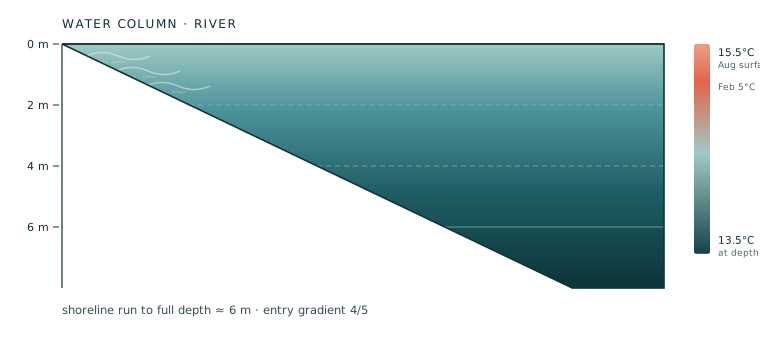
The surface runs about 15.5 °C in August. The annual low is 5 °C in January and the high is 15.5 °C in July. No pronounced summer thermocline is recorded here. For October, the mean surface figure is 11 °C.
| Jan | Feb | Mar | Apr | May | Jun | Jul | Aug | Sep | Oct | Nov | Dec |
|---|---|---|---|---|---|---|---|---|---|---|---|
| 5 | 5 | 7 | 10 | 12.5 | 14.5 | 15.5 | 15.5 | 14 | 11 | 8 | 6 |
Safety safety
Among the cleanest bathing waters in Europe on every Swiss GSchV parameter. The flip side is that the water is nutrient-poor and cold, so do not expect to warm up quickly once you are in.
Safety notes (3)
- Do not jump. Ever. The Verzasca's reputation for deaths comes almost entirely from jumping into water whose depth cannot be read from above.
- Currents between potholes are strong even when the surface looks glassy. The constriction near the bridge funnels the whole river into a 6 m gap.
- Upstream hydroelectric releases change the level abruptly. If the water starts to rise and discolour at the edges, exit within 60 seconds.
Where to get in
- Granite shelf, gradual — 80 m upstream of the bridge on the right bank; the only genuinely gradual entry, and the one local families use.
- Bridge jump (do not) — The arch jump is the reason this site appears in accident statistics every summer. Submerged granite blocks sit off the line most jumpers expect.
On site
- Grotti (stone huts) serving polenta 300 m up the village lane
- Seasonal WC by the car park, CHF 1
- No lifeguard; Ticino has a dedicated river-rescue team that is called out here most weekends
Getting there arrival · entry · exit
Getting there
Lavertezzo is 25 minutes from Locarno on the valley road. Park in the village and walk down — the roadside spaces near the bridge are for residents and get ticketed hard in July and August.
Scout from the bridge before you commit. From the parapet you get a clean top-down view of the shelf and can watch two or three other swimmers enter, which tells you more about depth than any description.
Getting in
Use the upstream granite shelf on the right bank. It gives you a sloping ramp into knee-deep water for the first five metres, then a clean edge into a 1.5 m basin — enough depth to swim properly without the pothole risk.
Keep to the basin. The classic swim here is small: a 15 m there-and-back between two rock walls, repeated. Resist the urge to explore downstream; that is where the depth becomes unreadable.
Getting out
The shelf dries in the sun until about 16:30 and is warm underfoot — a genuine advantage over the granite on the shaded side, which stays cold enough to numb feet in five minutes.
Change at the car park, not on the rocks. The village has a long-running campaign against swimmers changing in public, and the fine is CHF 100.
Depth profile
Not a pool but a chain of potholes carved into granite. Depths jump without transition: 20 cm on the polished shelf, then 4–8 m in the next metre. Because the granite is pale and the water is almost invisible against it, there is no visual cue at the edge — the only reliable method is to probe ahead with a pole or watch where others enter.
Season window
June to September; the valley is in shade after 17:00 from mid-August
Cold-water questions
- Why do people die in the Verzasca if it looks calm?
- Three reasons combine: extreme clarity removes all depth cues, granite potholes create sudden 8 m drops, and jumpers enter water that is 12–15 °C, which can trigger an uncontrollable gasp on contact.
- Is there a safe family spot on the Verzasca?
- The upstream granite shelf at Lavertezzo, and the shallow braided section at Ponte Brolla, are the two most-used family entries. Both still require constant supervision.
Before you get in
Cold water is the one hazard that applies everywhere in this library. Below 15 °C the gasp reflex can make you inhale water involuntarily within seconds of immersion; below 10 °C, unacclimatised swimmers lose the ability to swim effectively within minutes. Enter gradually, keep your first session under five minutes, never swim alone, and get out while you still feel fine — the afterdrop continues after you leave the water.
Informational only. Stillwater is not a safety authority, a lifeguard service or a medical source, and nothing here is professional advice. Water conditions change within hours: temperatures are monthly means, not today's reading, and depth profiles are typical rather than surveyed. Before you enter any water, check the current conditions, read the on-site signage, follow the advice of local lifeguards above anything on this page, and if you are unsure of your ability in cold water, do not go in.
Other spots of the same water type
| River Wharfe at Grassington | Yorkshire Dales, England | 3 m | 11.5° October |
| Berounka at Branov | Central Bohemia, Czechia | 2.2 m | 12° October |
| River Wye at Symonds Yat | Herefordshire / Gloucestershire border, England | 3.5 m | 12.5° October |
| Soča at Bovec | Julian Alps, Slovenia | 3.2 m | 9.5° October |