
Dashboard / Sea / Bude Sea Pool
Bude Sea Pool
A 91 m tidal pool cut into the rocks below Summerleaze Down in 1930 — filled by every high tide, sheltered from the Atlantic swell, and free to use.
Monthly water temperature temperature
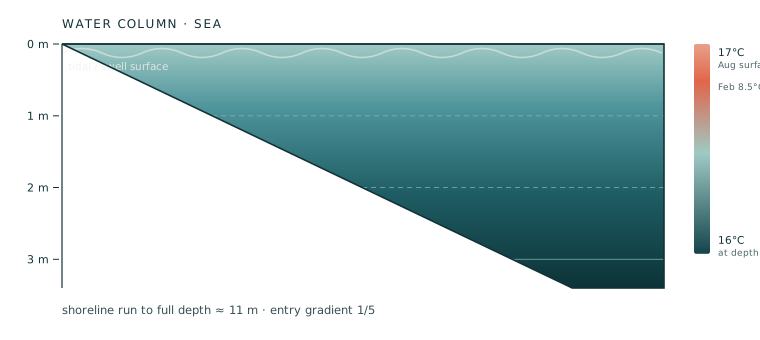
The surface runs about 17 °C in August. The annual low is 8.5 °C in February and the high is 17 °C in August. No pronounced summer thermocline is recorded here. For October, the mean surface figure is 14.5 °C.
| Jan | Feb | Mar | Apr | May | Jun | Jul | Aug | Sep | Oct | Nov | Dec |
|---|---|---|---|---|---|---|---|---|---|---|---|
| 9 | 8.5 | 8.5 | 9.5 | 12 | 14.5 | 16.5 | 17 | 16.5 | 14.5 | 12.5 | 10.5 |
Safety safety
The pool is refilled by the tide twice a day, so its water is Atlantic seawater at local sea temperature. Bude is a designated bathing water and has held an Excellent classification in every Environment Agency season since 2015.
Safety notes (3)
- The pool is only as safe as the tide. In a big Atlantic swell, waves break over the seaward wall and the pool can develop a strong current along the eastern wall — the lifeguards close it when that happens.
- Do not swim from the outer rocks when the swell is over 1 m. Bude has rip currents at the river mouth 200 m north.
- At low tide the pool empties to ankle depth and the floor is slippery with algae. Wait for the incoming tide rather than swimming in 20 cm of water.
Where to get in
- Shallow steps (west) — Three wide concrete steps into 0.5 m; the standard family entry.
- Diving platform (east) — 1 m and 3 m boards over 3.4 m of water. Fixed boards, inspected annually, and the only place jumping is sanctioned.
- Rock shelf at low tide — Outside the western wall at low water you can step into the open sea — but only in flat conditions.
On site
- Showers (cold) and open-air changing at the pool wall
- Lifeguard station on the eastern platform, May–September
- Beach café and two pubs within 300 m
Getting there arrival · entry · exit
Getting there
From Summerleaze car park, walk to the sea wall and turn north; the pool is cut into the cliff below the golf course and is visible from the top of the slipway. Five minutes, all downhill.
Check the tide table before you go. The pool is at its best in the three hours either side of high water; at low tide it is a shallow puddle and the swimmers move to the open beach instead.
Getting in
Use the western steps. They put you in 0.5 m of water with a handrail, and the floor slopes away predictably towards the diving end.
Swim lengths. The pool is 91 m long, which makes 10 lengths exactly 910 m — a proper session. Because the walls reflect the swell, the water is often choppier than the open sea on a windy day.
Getting out
Exit at the same steps, or use the ladder on the northern wall which is closer to the changing area.
Rinse in the outdoor showers immediately — the pool holds seawater for a full tidal cycle and salt stays on the skin.
Depth profile
A rectangular artificial basin with a concrete floor that slopes from 0.5 m at the western steps to 3.4 m at the eastern end near the diving platform, so the pool is genuinely swim-training depth. Above the eastern wall the natural rock shelf continues into open sea.
Season window
All year; lifeguarded 10:00–18:00 from May to September
Cold-water questions
- Is Bude Sea Pool free?
- Yes. It is maintained by the Friends of Bude Sea Pool charity and has no entry charge; donations at the gate fund the annual maintenance and lifeguard cover.
- When is Bude Sea Pool best for swimming?
- From three hours before to three hours after high water, when the pool is full and the concrete floor is covered to at least 2 m at the diving end.
Before you get in
Cold water is the one hazard that applies everywhere in this library. Below 15 °C the gasp reflex can make you inhale water involuntarily within seconds of immersion; below 10 °C, unacclimatised swimmers lose the ability to swim effectively within minutes. Enter gradually, keep your first session under five minutes, never swim alone, and get out while you still feel fine — the afterdrop continues after you leave the water.
Informational only. Stillwater is not a safety authority, a lifeguard service or a medical source, and nothing here is professional advice. Water conditions change within hours: temperatures are monthly means, not today's reading, and depth profiles are typical rather than surveyed. Before you enter any water, check the current conditions, read the on-site signage, follow the advice of local lifeguards above anything on this page, and if you are unsure of your ability in cold water, do not go in.
Other spots of the same water type
| The Forty Foot, Sandycove | County Dublin, Ireland | 6 m | 14° October |
| Pomena, Mljet | Dalmatia, Croatia | 22 m | 20° October |