
Dashboard / River / Upper Rhine at Rheinau
Upper Rhine at Rheinau
A broad, fast, island-fringed stretch of the Rhine where the standard local swim is a 1.2 km downriver drift between two bridges.
Monthly water temperature temperature
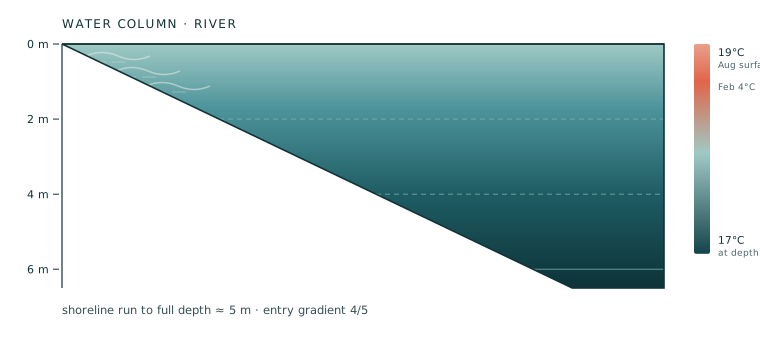
The surface runs about 19 °C in August. The annual low is 4 °C in January and the high is 19 °C in July. No pronounced summer thermocline is recorded here. For October, the mean surface figure is 13 °C.
| Jan | Feb | Mar | Apr | May | Jun | Jul | Aug | Sep | Oct | Nov | Dec |
|---|---|---|---|---|---|---|---|---|---|---|---|
| 4 | 4 | 6 | 9.5 | 13.5 | 17 | 19 | 19 | 16.5 | 13 | 9 | 6 |
Safety safety
The Rhine at Rheinau is monitored under the Swiss GSchV and the international Rhine monitoring programme. It is consistently rated good for bathing, with the caveat that a river this size mixes in whatever the upstream cantons have discharged.
Safety notes (3)
- This is a drift swim, not a circuit. You cannot swim back upstream at 1.5 m/s. Plan the exit before you enter and never swim this stretch alone.
- The Rhine carries commercial and pleasure traffic. Stay within 30 m of the bank, well outside the buoyed navigation channel.
- Water temperature of 19 °C in August drops to 16 °C in a 30-minute drift because the current mixes colder water up from depth. Budget for that.
Where to get in
- Gravel bar walk-in — Island bend inside bank; firm gravel for 20 m then a sharp drop to 3 m. Enter here, drift, and get out at the same bar.
- Monastery steps — Stone steps below the monastery wall into 2 m of slower water behind the island — a good option when the main channel is running high.
On site
- Rheinau monastery shop and café
- Official changing area with lockers at the gravel bar (May–September)
- No lifeguard; the local swim club runs a supervised Sunday drift in July and August
Getting there arrival · entry · exit
Getting there
Rheinau is 15 minutes from Schaffhausen by road or a direct S-Bahn from Winterthur. Park by the monastery and walk down to the gravel bar, five minutes on a signed path.
Check the gauge board at the bar before you get changed. The local swim club posts a green/amber/red board tied to discharge; amber means drift only with a partner, red means no entry.
Getting in
Enter from the upstream end of the gravel bar and commit straight to the current. There is no eddy to stand in — the moment you pass the bar's tip you are moving at river speed.
Roll onto your front and swim a relaxed front crawl, using the current as free distance. The 1.2 km to the Rheinau power station bridge takes a fit swimmer 12–14 minutes and a leisurely one 20.
Getting out
Take out at the gravel bar on the second bend, 300 m before the power station weir. Miss it and you are committed to the weir pool, which has no safe exit.
Walk back along the bank path, 10 minutes, in whatever you swam in plus a towel. There is no shuttle except the Sunday club run.
Depth profile
Deep throughout. The navigation channel beside Rheinau island is 6–7 m and the bed is not visible at any point. The only shallow water is a 20 m gravel bar on the inside of the island bend, which is 40–80 cm deep and serves as the entry and exit beach.
Season window
July to early September; the Rhine runs 1–2 °C warmer than the lakes that feed it
Cold-water questions
- How fast does the Rhine flow at Rheinau?
- Around 1.3–1.6 m/s at summer mean discharge, which is faster than most casual swimmers can sprint.
- Do you need a tow float on the Rhine?
- It is strongly recommended and required by the local club for supervised drifts — you are sharing the water with boats and a bright float is the only thing a helm can see at 40 m.
Before you get in
Cold water is the one hazard that applies everywhere in this library. Below 15 °C the gasp reflex can make you inhale water involuntarily within seconds of immersion; below 10 °C, unacclimatised swimmers lose the ability to swim effectively within minutes. Enter gradually, keep your first session under five minutes, never swim alone, and get out while you still feel fine — the afterdrop continues after you leave the water.
Informational only. Stillwater is not a safety authority, a lifeguard service or a medical source, and nothing here is professional advice. Water conditions change within hours: temperatures are monthly means, not today's reading, and depth profiles are typical rather than surveyed. Before you enter any water, check the current conditions, read the on-site signage, follow the advice of local lifeguards above anything on this page, and if you are unsure of your ability in cold water, do not go in.
Other spots of the same water type
| River Wye at Symonds Yat | Herefordshire / Gloucestershire border, England | 3.5 m | 12.5° October |
| River Dart at Newbridge | Devon, England | 2.6 m | 12.5° October |
| Berounka at Branov | Central Bohemia, Czechia | 2.2 m | 12° October |
| River Wharfe at Grassington | Yorkshire Dales, England | 3 m | 11.5° October |