
Dashboard / Sea / Greve de Lecq, Jersey
Greve de Lecq, Jersey
A north-facing Jersey bay with one of the largest tidal ranges in the world — 11 m between high and low water — so the beach is a different shape every time you visit.
Monthly water temperature temperature
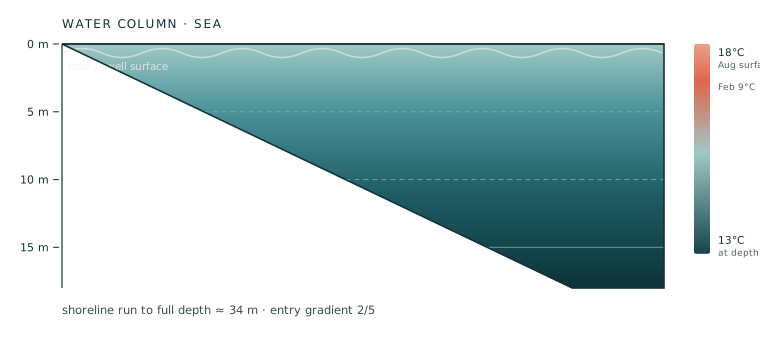
The surface runs about 18 °C in August. The annual low is 9 °C in February and the high is 18 °C in August. No pronounced summer thermocline is recorded here. For October, the mean surface figure is 15.5 °C.
| Jan | Feb | Mar | Apr | May | Jun | Jul | Aug | Sep | Oct | Nov | Dec |
|---|---|---|---|---|---|---|---|---|---|---|---|
| 9.5 | 9 | 9.5 | 11 | 13 | 15.5 | 17.5 | 18 | 17.5 | 15.5 | 13 | 11 |
Safety safety
Jersey's bathing waters are sampled by the States of Jersey under the UK bathing-water regulations and Greve de Lecq has held 'Excellent' since 2016. The bay is outside the main St Helier harbour discharge and the tidal exchange is exceptional.
Safety notes (3)
- The tide falls faster than a walking pace in places and rises behind you around the headlands. Check the tide table and never let the rising water cut you off against the cliffs.
- At low water the sea is 400 m out over wet rock — do not walk out on the exposed reef without checking the return time; several rescues a year here are for cut-off walkers, not swimmers.
- The bay faces north and takes Atlantic swell directly. When the swell is over 1.5 m the slipway is unusable.
Where to get in
- Concrete slipway — Slipway at the western end; step straight into 2 m at high water, long walk over sand at low.
- Sand beach — Mid-beach; the shallow sand flat is the family area, lifeguarded at weekends in summer.
- Rock pools (east) — Low-tide rock pools below the castle; deep enough for a dip at the largest, but check the tide return time.
On site
- Two beach cafés and a pub overlooking the bay
- Public toilets at the car park
- Lifeguard patrol 10:00–18:00 at weekends, June–September
Getting there arrival · entry · exit
Getting there
From St Helier take the A9 north for 15 minutes; the bay is signposted from the coast road. Jersey's bus network runs to the bay on route 9, hourly in summer.
Check the tide table before you pack. The single most common mistake at Greve de Lecq is arriving at low water expecting to swim and finding a 400 m walk to the sea.
Getting in
At high water use the slipway — a clean step into 2 m. At mid-tide walk in from the sand flat, which gives you 300 m of waist-deep water and is the most forgiving sea entry in the Channel Islands.
Swim across the bay rather than out to sea: it is about 400 m from the slipway to the eastern rocks, and the water reaches 18 m in the middle, which makes it a real open-water swim rather than a paddle.
Getting out
Aim for the slipway at any state of tide — it is the only hard surface on the beach and the only place the sand does not shift underfoot.
If you swam at low water, note that the walk back may be 400 m over sand. Carry shoes down to the waterline rather than leaving them on the slipway.
Depth profile
The profile changes with the tide more than at any other site here. At high water you step off the slipway into 2 m; at low water the same slipway ends 400 m from the sea over exposed sand and rock. Between them the beach is a shallow 1 m sand flat for 300 m, then falls to 18 m in the middle of the bay.
Season window
June to September; lifeguards patrol at weekends from May
Cold-water questions
- What is the tidal range at Greve de Lecq?
- Up to 11 m on a spring tide — among the largest in the world. At low water the sea is roughly 400 m from the slipway.
- Is Greve de Lecq good for children?
- At mid to high tide the sand flat gives 300 m of shallow water, which is excellent for children. The main risk is the tide, not the water — watch the rising line.
Before you get in
Cold water is the one hazard that applies everywhere in this library. Below 15 °C the gasp reflex can make you inhale water involuntarily within seconds of immersion; below 10 °C, unacclimatised swimmers lose the ability to swim effectively within minutes. Enter gradually, keep your first session under five minutes, never swim alone, and get out while you still feel fine — the afterdrop continues after you leave the water.
Informational only. Stillwater is not a safety authority, a lifeguard service or a medical source, and nothing here is professional advice. Water conditions change within hours: temperatures are monthly means, not today's reading, and depth profiles are typical rather than surveyed. Before you enter any water, check the current conditions, read the on-site signage, follow the advice of local lifeguards above anything on this page, and if you are unsure of your ability in cold water, do not go in.
Other spots of the same water type
| Bude Sea Pool | Cornwall, England | 3.4 m | 14.5° October |
| The Forty Foot, Sandycove | County Dublin, Ireland | 6 m | 14° October |
| Pomena, Mljet | Dalmatia, Croatia | 22 m | 20° October |
| Cala Macarella, Menorca | Balearic Islands, Spain | 14 m | 22° October |