
Dashboard / Sea / Cala Macarella, Menorca
Cala Macarella, Menorca
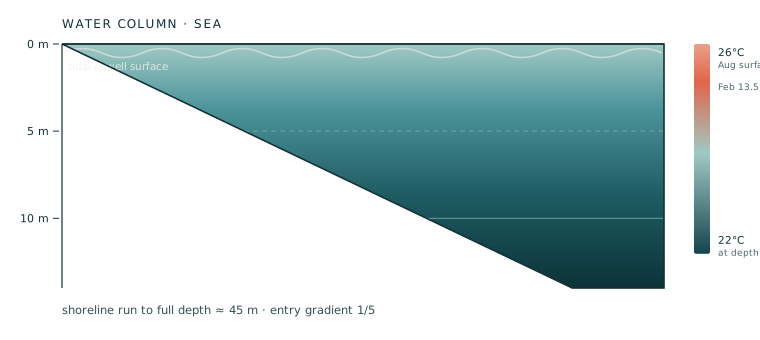
A horseshoe cove of white sand and turquoise water on Menorca's south coast, reachable only on foot in summer, with a shallow shelf that runs 40 m before you need to swim.
Monthly water temperature temperature
The surface runs about 26 °C in August. The annual low is 13.5 °C in February and the high is 26 °C in August. No pronounced summer thermocline is recorded here. For October, the mean surface figure is 22 °C.
| Jan | Feb | Mar | Apr | May | Jun | Jul | Aug | Sep | Oct | Nov | Dec |
|---|---|---|---|---|---|---|---|---|---|---|---|
| 14 | 13.5 | 14 | 15.5 | 18.5 | 22 | 25 | 26 | 25 | 22 | 19 | 16 |
Safety safety
Menorca's bathing waters are sampled by the Balearic government under the EU directive and Macarella has held 'excellent' every season for over a decade. The Posidonia meadows are a protected habitat and anchoring on them is prohibited.
Safety notes (3)
- There is no shade after 11:00 in July and August. Menorca's south coast gets full sun from the sea; heat exhaustion is a bigger risk here than drowning.
- Day boats enter the cove to anchor in the afternoon. Swim within the buoyed swimming zone — propellers are the most common injury source at Balearic coves.
- Jellyfish (Pelagia noctiluca) appear in some years in late August and September. Check the beach flag board: purple means jellyfish present.
Where to get in
- White sand beach — Both ends of the cove give walk-in entry over firm sand; the eastern end is quieter.
- Rock ledges (west headland) — Flat limestone ledges with ladders used by locals for a straight deep-water start.
On site
- Seasonal beach bar (June–September) with water and snacks
- No toilets; the nearest are at Cala Galdana
- Lifeguards on duty in July and August only
Getting there arrival · entry · exit
Getting there
In July and August the access road is closed to cars at the Cala Galdana barrier and you walk the 3.2 km in — about 35 minutes on a shaded pine path with the sea in view for the last kilometre. Outside those months you can drive to within 200 m.
Come before 09:30. The cove is small and by noon in high season there is no bare sand left, and no shade anywhere.
Getting in
Walk straight in. With 40 m of sand before you reach 1.5 m, this is the easiest entry of any sea spot on this list and the best one for children and nervous swimmers.
For a proper swim, head for the channel between the headlands where the depth reaches 10–14 m, and swim the 250 m across the mouth of the cove. The water is 26 °C in August and holds 22 °C into October.
Getting out
Walk out anywhere on the sand. The beach is gently sloped and there are neither rocks nor urchins.
Rinse at the beach bar tap or bring fresh water — Menorca's south coast coves have no showers, and the salt dries to a noticeable crust in the sun.
Depth profile
A textbook Mediterranean cove profile: fine white sand to 1.5 m at 40 m out, 3 m at 80 m, then a sandy channel between the two headlands that reaches 14 m. Posidonia seagrass meadows start at about 6 m on both flanks — they are why the water is so clear and so intensely turquoise.
Season window
May to October; access by car is closed in July and August
Cold-water questions
- Why is Cala Macarella water so turquoise?
- White sand and Posidonia seagrass meadows on a pale limestone bed reflect light back through very clear, nutrient-poor water — the combination produces the characteristic Balearic colour.
- Can you drive to Cala Macarella in summer?
- No — in July and August the access road is closed at the Cala Galdana barrier, and visitors walk the 3.2 km. Outside those months there is limited parking at the cove.
Before you get in
Cold water is the one hazard that applies everywhere in this library. Below 15 °C the gasp reflex can make you inhale water involuntarily within seconds of immersion; below 10 °C, unacclimatised swimmers lose the ability to swim effectively within minutes. Enter gradually, keep your first session under five minutes, never swim alone, and get out while you still feel fine — the afterdrop continues after you leave the water.
Informational only. Stillwater is not a safety authority, a lifeguard service or a medical source, and nothing here is professional advice. Water conditions change within hours: temperatures are monthly means, not today's reading, and depth profiles are typical rather than surveyed. Before you enter any water, check the current conditions, read the on-site signage, follow the advice of local lifeguards above anything on this page, and if you are unsure of your ability in cold water, do not go in.
Other spots of the same water type
| Pomena, Mljet | Dalmatia, Croatia | 22 m | 20° October |
| Bude Sea Pool | Cornwall, England | 3.4 m | 14.5° October |
| The Forty Foot, Sandycove | County Dublin, Ireland | 6 m | 14° October |
| Kvalvika Beach, Lofoten | Nordland, Norway | 40 m | 9° October |